Design and technical preparation · €2,000
Assumed drawings, coordination and basic technical review. Ask whether structural calculations, revision rounds and venue submission fees are included or separate.
European stand cost guide
Calculate a scope-specific planning total from your own quote lines, then use the guide to identify missing services, assumptions and cost risks before supplier approval.
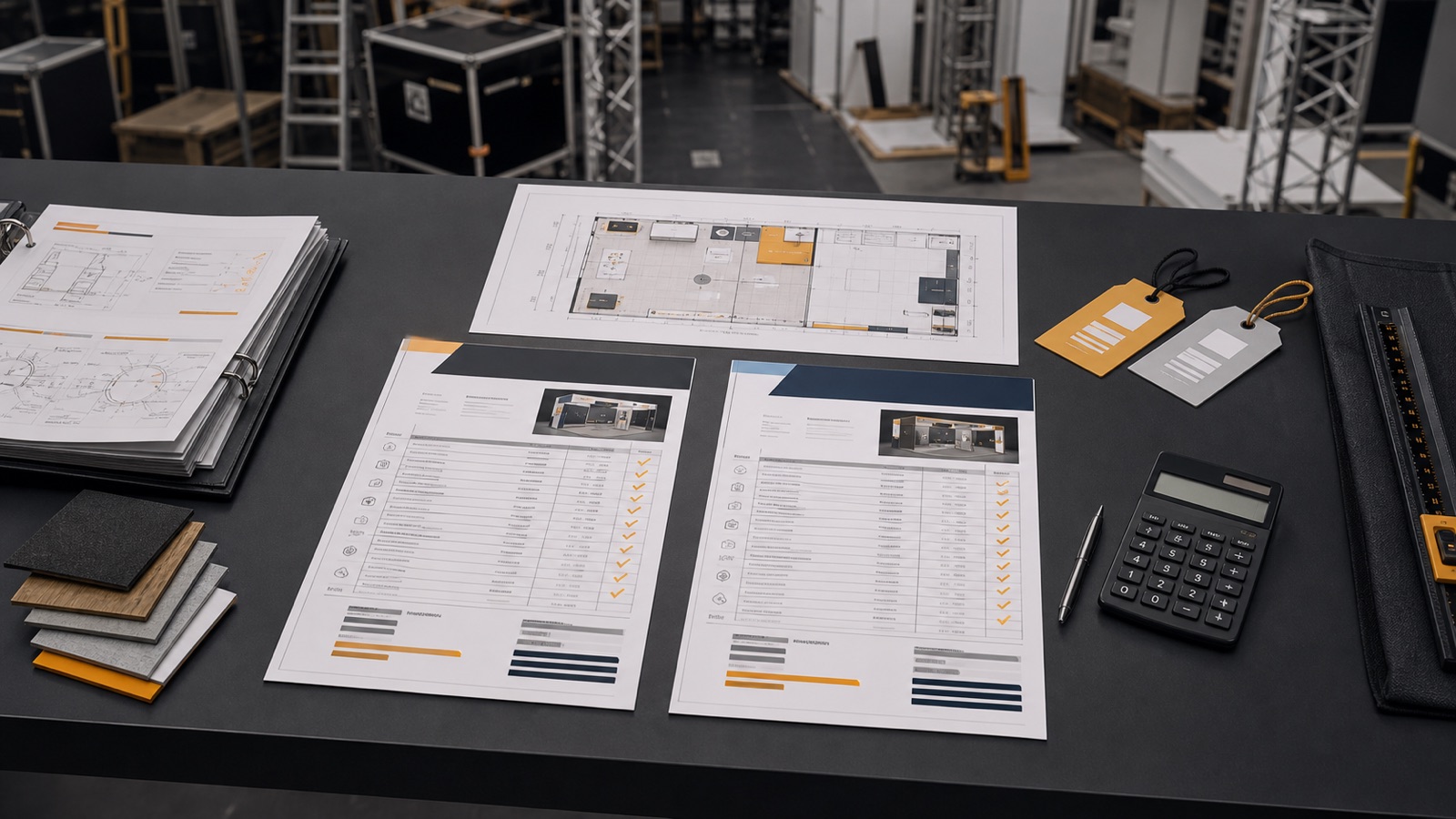
Free budget worksheet
Enter your own quote lines to calculate the known delivery subtotal, contingency and a scope-specific cost per square metre. The result reflects only your inputs; it is not a European market rate or supplier quote.
Budget worksheet · illustrative only
There is no verified BuildAcross market-wide price per square metre. The example below is a fictional planning exercise for a single-storey 48 m² stand. It is not a current supplier offer, a typical European price or a promise that your project can be delivered for this amount. Its purpose is to show the costs that disappear when a proposal is reduced to one headline rate.
Assume one event, a straightforward build, basic furniture and graphics, with no suspended structure, double deck or specialist demonstration equipment. The assumed delivery subtotal is €24,000 excluding VAT, floor-space rental and the exhibitor's travel, staff and marketing costs. A separately chosen 10% contingency adds €2,400, producing a €26,400 working allowance. Replace every input with actual project quotations before making a purchase decision.
Assumed drawings, coordination and basic technical review. Ask whether structural calculations, revision rounds and venue submission fees are included or separate.
Assumed manufacture or system hire, floor, counters, wall finishes and printed graphics. Specify what is rented, what is bought and what must be returned.
Assumed on-site crew and agreed working periods. Confirm supervision, accommodation, overtime triggers and the dismantling scope rather than accepting an unexplained labour allowance.
Assumed outbound and return freight plus handling. A delivery to the venue gate is not necessarily a delivery to the stand; lifting, storage and waiting may be separate.
Assumed basic utilities and rentals. Match actual electricity, connection, internet and equipment orders to the design; specialist loads or permanent power are not assumed here.
Assumed coordination and handover. Avoid double counting a fee already included in other lines, and record who owns service orders and outstanding changes.
In the fictional example, €24,000 ÷ 48 m² = €500/m² before contingency. The same project including the chosen contingency is €550/m². Neither number is a European market benchmark. Both describe one set of assumptions, and neither includes floor-space rental. A proposal with a different definition of ‘all-in’ cannot be compared directly.
Do not scale a 24 m² stand to 96 m² by multiplying every line by four. Design, transport mobilisation and management can contain fixed costs, while finishes and graphics depend on their actual quantities. A compact stand with substantial AV, product loads and enclosed rooms may cost more per square metre than a larger simple open layout. Price the bill of materials and delivery plan, then use the area ratio as a sense-check.
When comparing quotations, normalize both the base scope and uncertainty. If fictional quote A is €22,000 plus an excluded €3,000 of venue and handling costs, its comparable total is €25,000. If fictional quote B is €24,000 with those same costs included, B is €1,000 lower on that defined scope. Check quality, dates, ownership and risk before selecting either option; arithmetic alone does not establish capability.
Start with the purpose of the stand: meetings, demonstrations, product display or lead capture. Protect the space and equipment that support that purpose. Ask the builder to price specific alternatives, such as a reusable wall system instead of custom joinery, a simpler counter detail, fewer finish changes or rental furniture. Do not request an unexplained percentage discount while keeping every specification unchanged.
Separate a one-show decision from a multi-show decision. For repeat use, compare acquisition or rental, each installation, transport, storage, repairs, replacement graphics and final disposal. Reuse is only economical if the parts fit future footprints, can survive handling and have a named storage owner. Ask for packed dimensions, condition-report procedures and an inventory before assuming savings.
Freeze the decisions that control production before discussing cosmetic extras. Maintain a change log with description, additional cost, approval owner and effect on schedule. A contingency is a planning buffer, not permission for unapproved work. Agree who can release it and how unused allowances will be treated. Confirm currency, tax treatment, payment milestones and cancellation terms with the supplier and your adviser; these are contract-specific.
Cost model
A square-metre benchmark may be useful for an early internal range, but it cannot tell you what a supplier has included. Two stands of the same size can require very different structures, finishes, crews and logistics. A defensible estimate separates the work into groups that can be checked.
Structure, flooring, finishes, counters, storage, graphics, electrical preparation and workshop labor.
Furniture, lighting, screens, audio, plants, appliances and any damage or cleaning conditions.
Packing, freight, handling, vehicle access, parking, empty-case storage and return transport.
Installation crew, supervision, overtime, badges, electricity, rigging, internet, water and organizer fees.
Dismantling, disposal, refurbishment, storage and ownership of reusable elements.
Quote comparison
Before comparing suppliers, place each proposal against the same list of requirements. Mark every line as included, excluded, allowance, optional or awaiting information. Then examine the assumptions behind labor hours, transport, venue orders and currency.
A quote that leaves major services open is not necessarily wrong, but the uncertainty should be visible. Ask who carries the cost if the installation window changes, artwork arrives late, venue access is restricted or a technical assumption proves false.
The supplier owns the stated work and price within clearly described conditions.
A provisional amount is included but may change after final quantity or supplier confirmation.
The agency or exhibitor must source, order or pay for the work separately.
Information is missing; a decision owner and deadline should be assigned before production release.
Cost control
The strongest cost control happens before supplier selection. Freeze the floor plan and key finishes, confirm service responsibilities, issue correct graphic dimensions and identify late-order surcharges. When design changes remain possible, define how they will be priced and approved.
Reusable or modular elements can reduce some production and disposal costs, but only when transport, storage, adaptation and future ownership are included in the decision. The lower workshop price is not automatically the lower project cost.
Working files
Primary venue sources
Frequently asked questions
Enter the stand area, each known quote line and your chosen contingency percentage. The calculator totals only those inputs and shows a scope-specific cost per square metre. It does not estimate a market price, supplier capability, VAT, floor-space rental or costs you have not entered.
A single figure is too imprecise for procurement. Stand type, finish level, venue, country, services, timing and reuse strategy can change the total substantially. Use a scope-based estimate.
Not automatically. Electricity, rigging, internet, water, waste, freight handling and organizer fees should each be marked as included, allowed for or excluded.
Materials, rental stock or specialist elements may travel from another region. Ask where each major component originates and whether return transport or empty-case storage is included.
Enough to establish a credible route without losing time or quality through uncontrolled bid volume. One to three normalized options may be more useful than many incomparable totals.
BuildAcross
Send the design and available cost breakdown. We will identify the missing scope, assumptions and likely European cost drivers.
Request a quote review